


Recordal of Intellectual Property Rights (“IPR”) with customs authorities is one of the standard pillars of a brand protection programme, and most Intellectual Property (“IP”) owners record their rights in multiple countries. While recordals themselves are usually not expensive, costs increase when it comes to providing training, an investment which may, or may not, be rewarded with regular detentions.
Looking at the data, does a “global” customs recordal programme covering dozens of countries really make sense, or should IP owners be more selective?
We have looked at data from several sources:
|
1. World Customs Organisation (WCO) annual reports |
|
From the latest 3 years (2022 and 2024).[1] This ranks countries by detention activity, although some important ones, notably Mainland China (“China”), are not included. |
|
2. European Union Intellectual Property Office (“EUIPO”) annual reports |
|
Covering 2022 to 2024 (the latest published Oct 2025)[2]. While this covers the EU only, it does so in more detail than the WCO report as it includes internal market enforcement as well. |
|
3. Metadata in CHORUS |
|
Rouse’s own brand protection case management database, covering the same period, with a total of 17,143 customs detention records from a range of IP owners[3] in different industries. |
|
4. The latest report from US Customs & Border Protection |
|
Fiscal year 2024[4]. To provide a comparison with data from the other reports. |
|
5. An OECD report “Mapping Global Trade in Fakes 2025”[5] |
|
Which provides detailed analysis and commentary characteristics of trade in counterfeits, although relying on data from 2021 from some of the same sources as above. |
The data from these various sources differ in the methodology of compilation and cannot be directly compared. For example, the EUIPO and US reports cover their specific jurisdictions only, while the WCO report is compiled from voluntary data submissions, which notably excludes some key countries, such as China. However, a consistent picture still emerges: there are no more than a few dozen countries which see a significant level of detention activity, and a long tail of other countries where an IP owner may rarely see any cases.
A compilation of the data sources above shows the following countries are frequently listed as having the highest the number of detentions in their regions (due to difficulty in “ranking” for reasons stated above, we list countries alphabetically). We have focused on number of detention cases as a true measure of activity, rather than number or value of articles. Most of the top-ranked countries here have consistently retained their positions, indicating that these are not temporary peaks in activity.
The data from these various sources differ in the methodology of compilation and cannot be directly compared. For example, the EUIPO and US reports cover their specific jurisdictions only, while the WCO report is compiled from voluntary data submissions, which notably excludes some key countries, such as China. However, a consistent picture still emerges: there are no more than a few dozen countries which see a significant level of detention activity, and a long tail of other countries where an IP owner may rarely see any cases.
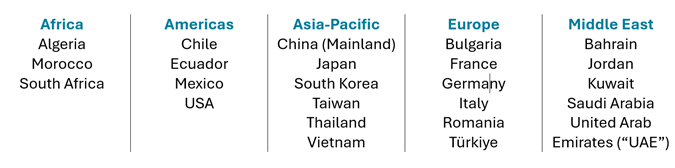
There are some important points to note about this data:
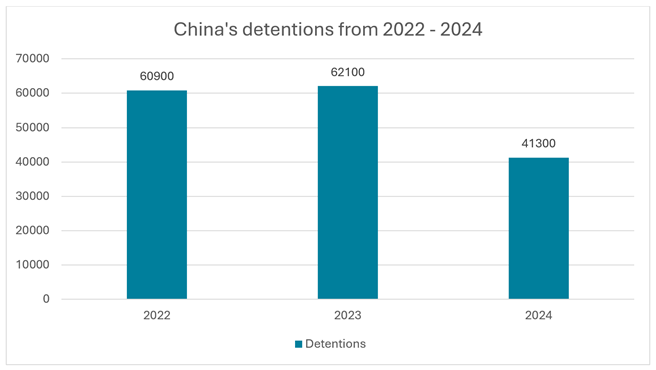
While the above data sources do not include China detentions, according to its own published statistics, China’s Customs General Administration reported 60,900 detentions in 2022, 62,100 in 2023 and 41,300 in 2024, which makes it the highest-ranked globally. China detentions are predominantly exports, given its role as the primary source of infringing products.
South Korea also does not appear in the WCO report but in our CHORUS database, which records actual cases for different brand owners, it is amongst the top-ranked for number of detentions.
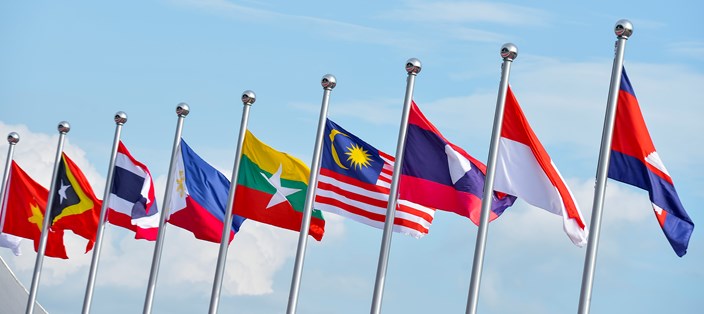
It is notable that the ASEAN member countries, despite being a major economic bloc, are poorly represented on this list. Apart from Thailand, most other countries in the region have insignificant volumes of detentions. Even Vietnam, which has a robust domestic enforcement system, and increasing importance as the destination of manufacturing migrating from China, has only published data on 42 major cases in the past consecutive years and 93 major cases in 2025. That said, actual detention numbers are likely to be higher, and some IP owners are seeing regular detentions there, as Vietnam customs are stepping up their activity, hence we have included it in our list as a rising star.
 In the MENA region, there is no published data except in Saudi Arabia, where Saudi Authority for Intellectual Property (SAIP) regularly publishes seizure statistics. However, our own CHORUS data shows that, within the region, Algeria, Bahrain, Jordan, Morocco, Saudi Arabia and in particular, the UAE, see consistent seizures. It is notable also that for the first time UAE appeared in the EU IPO report as the 3rd most common origin country for counterfeit goods, after Mainland China and Türkiye. As the UAE is a major transit hub, this is hardly surprising.
The EU is a special case, given its single market, and the fact that IP owners frequently make use of the EU-wide recordal and information system, reducing the need to select individual countries. While the countries with major ports of entry have the largest volumes of traffic, detention statistics are spread more evenly throughout the EU bloc.
Neighbouring Türkiye has an outsized impact on counterfeit traffic into the EU. After Mainland China and Hong Kong SAR, Türkiye is the top origin country for counterfeit goods, and this shows in the ranking of detentions in its neighbouring EU countries such as Bulgaria and Romania. While Türkiye has a strong track record of detentions of imports, this does little to address its role as a leading exporter of infringements.
As a customs recordal strategy, focusing resources on a small group of countries with a track record of regular detentions has obvious merit, especially for IP owners with limited budgets. Conversely, it makes little sense to file recordals in countries which, while having border protection measures in theory, have almost no detentions in practice.
 However, customs detentions are not simply about numbers – after all, even the most vigilant border authorities are stopping only a tiny fraction of overall imports. The true value in customs detentions lies in uncovering the parties involved in the shipment, which may lead to key players responsible for significant volumes. Without this additional intelligence, detentions are random dots on a map. Therefore, the degree to which customs procedures in a country can lead to valuable information disclosure is at least as important as the volume of detentions. In this respect, the EU regulations providing for information disclosure of the importer at the request of the IP owner is one of the more effective systems.
In industries with a high volume of small consignments (such as clothing sent by parcel) the cost of responding to detentions becomes a major consideration. For such IP owners, there is a balance to strike to avoid being overwhelmed by low value cases. By contrast, in some industries, such as industrial components, shipments are high-value and infrequent. For these IP owners, any detention, regardless of size, could be valuable in uncovering leads to a significant player.
Nevertheless, even low value detentions may provide useful intelligence. Two of the reports cited above note an increase in the number of labels and packaging materials seized: part of a rising trend of products and labels shipped separately for final assembly in the destination market. Using detentions of packaging materials to build intelligence on localised assembly is more valuable than the goods themselves. There are also examples where large numbers of small parcel detentions have been linked to a common source or destination, providing a valuable lead. The key here is to have systems in place for managing case intelligence.
Outside of the top-ranked customs offices, recordals and training should also take into account specific markets which may be emerging enforcement hotspots, even though they currently have a low volume of detentions. Being early in fostering relationships with customs offices as they build capacity can reap dividends. As noted above, Vietnam is an example of a jurisdiction where investment is likely to pay off in the short term, likewise Tanzania, which has recently implemented a mandatory trade mark recordal system for importers. Patterns of counterfeit trade are always shifting, and today’s apparently “quiet” jurisdiction can become a hotspot later. Relationship-building and training can be the catalyst for new cases for IP owners, uncovering previously unknown problems, and fostering information sharing.
In devising a customs strategy, IP owners should carefully consider where to invest resources, avoiding the cost and administrative burden of blanket coverage of countries where detentions are very infrequent. They should be considering not only where they are most likely to achieve detentions, but also where they can obtain intelligence on patterns of trade and key parties involved in regular shipments of counterfeit goods.
[1] World Customs Organization, Enforcement & Compliance, Illicit Trade Report, found at https://www.wcoomd.org/en/topics/enforcement-and-compliance/resources/publications.aspx.
[2] EU enforcement of intellectual property rights, results at the EU border and in the EU internal market 2024, found at https://www.euipo.europa.eu/en/publications/eu-enforcement-of-intellectual-property-rights-results-2024.
[3][3] See https://www.chorus-site.rouse.com/
[4] US CBP Intellectual Property Rights Seizure Statistics at https://www.cbp.gov/trade/priority-issues/ipr/statistics
[5] Found at https://www.oecd.org/en/publications/mapping-global-trade-in-fakes-2025_94d3b29f-en.html


