

Thailand's Department of Intellectual Property (DIP) has published IP filings statistics for the first half of 2026 (January – June 2026) via their official Facebook page on 21 July 2026 (https://www.facebook.com/share/p/195YtEgr3K/). In the first of our two-part series, this article covers trade marks and copyright. Overall, the data shows an increase across all IP applications and registrations vs the same period in the previous year.
Key Highlights
Trade Marks
Trade mark filings and registrations have increased compared with the previous year.
|
Metric |
Value |
Change vs. Same Period Previous Year |
|
Trade mark Applications Filed |
28,507 |
+8.01% |
|
Trade mark Registrations Granted |
22,189 |
+5.91% |
|
Registrations as % of Applications |
~ |
77.8% |
While filings and registrations are not necessarily from the same set of applications, the figures indicate substantial trade mark processing and registration activity during the reporting period.
Applicant Origin
Thai applicants represented a slight majority of filings at 56%, and foreign participation remained significant at 44% of total applications.
Although Thai applicants represent the majority of filings, foreign participation remains very strong, accounting for nearly half of all applications, suggesting continued international interest in protecting brands in Thailand.
Top 5 Trade Mark Applicants
The top 5 trade mark filers are listed below:
All five leading applicants are Thai companies, all are in the agriculture business. This mirrors the higher local applicant source and reflects the strong agricultural businesses in rural Thailand.
Top 5 Product/Service Categories
The product/service groups that generated the largest number of trade mark applications are as follows:
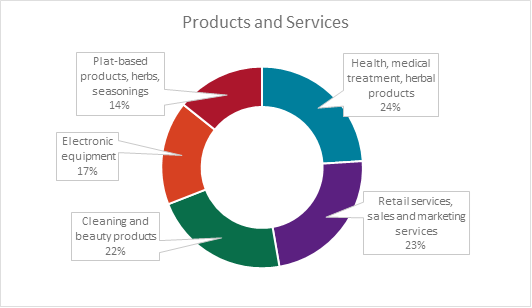
Health-and consumer-related sectors led trade mark activity, with Retail and marketing services a close second. Beauty and cleaning products remain a major branding sector, while Electronics continue to generate substantial trade mark activity. Plant-based and herbal products also show strong demand, reflecting continued commercial interest in food, herbal, and agricultural products.
Conclusion – Trade Marks
Trade mark activity in Thailand continued to grow in the first half of 2026, with both filings and registrations increasing year-on-year. The trend aligns with the fastest-growing business sectors, particularly those driven by digital transformation, AI adoption, healthcare and the needs of an aging society.
Thai applicants represented a slight majority of filings, with foreign participation at 44% of total applications. This continued level highlights Thailand's attractiveness as a market for innovation, consumer products, and technology-enabled services.
These figures suggest an increasingly competitive trade mark landscape as businesses enter into fast-growth sectors. Brand owners should adopt more proactive approach to trade mark clearance and protection of key brands well before launching new products or services.
Beyond registration, brand owners should actively monitor both physical and online marketplaces for potentially conflicting applications, unauthorized use, and emerging infringement risks. Early planning, proactive portfolio management, and ongoing enforcement efforts can help safeguard valuable brand assets and minimize the risk of costly disputes, and avoid launch delays or rebranding as competition for distinctive brands intensifies.
Copyright
Copyright works in Thailand are automatically protected under the Copyright Act B.E. 2537 (1994), which complies with international global treaties like the Berne Convention and TRIPS and does not require registration. Nevertheless, Thailand’s DIP maintains a Copyright Recordation Notification system allowing voluntarily recordal of copyright works. Copyright protection does not require or arise out of such recordation.
As such, copyright recordation activity is overwhelmingly used by local creators at 99%. The recordation saw a 33% increase compared to the same period in the previous year. This represents a substantial increase compared with the previous year and indicates growing awareness and use of copyright recordation services.
Top 5 Recording Entities
All five leading entities are Thai Universities: Khon Kaen University (159 recordals), Mahidol University (143 recordals), Thaksin University (129 recordals), Rajamangala University of Technology Isan (71 recordals), Pibulsongkram Rajabhat University (70 recordals). This reflects active creation of academic works, educational materials, research publications, artistic content, and other copyrightable works within Thailand's higher education sector, which may include research publications, teaching materials, creative works, and academic outputs.
Top 5 Categories of Copyright Works
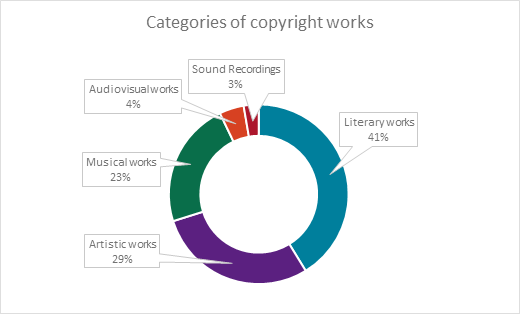
Literary works form the largest category (3,675 recordals). This includes books, academic publications, research outputs, written materials, software-related literary works, and other written content. Artistic works rank second (2,576 recordals), demonstrating strong creative activity in visual arts, graphic design, illustrations, and related fields. Musical works (2,024 recordals), audiovisual works (394 recordals) and sound recordings (240 recordals) show continued activity in media and entertainment industries.
Conclusion - Copyright
During the first six months of 2026, Thailand recorded 9,069 copyright work notifications, representing a strong 33.62% increase from the same period in the previous year. The largest categories were literary works (3,675), artistic works (2,576), and musical works (2,024). Thai rights holders accounted for 99% of notifications, reflecting the active participation of domestic copyright owners to protect their works.
Concluding remarks
Taken together, the first-half 2026 figures point to a Thai IP landscape that is not only expanding, but becoming more strategically important for both domestic and international rights holders. Growth in trade mark activity reflects intensifying competition for distinctive brands, while copyright recordation highlights growing awareness among Thai creators and academic bodies of the value of documenting creative assets. For businesses entering or expanding in Thailand, these trends underscore the need to treat IP protection as an early commercial priority rather than a later compliance exercise. Readers who would like to better understand how these developments may affect their brand, portfolio strategy, or enforcement approach are encouraged to explore the data further and contact the authors with any questions.
Authors: Terapat Laopatarakasem (trade marks) and Karat Gedkhuntod (copyright)

