

We would like to highlight a recent development concerning the legalisation of documents by UAE Consulates outside the UAE, which is directly relevant to Intellectual Property practice and day-to-day work we undertake on behalf of our clients.
UAE Consulates abroad have recently introduced a new legalisation page format, which is now issued electronically, as shown in the image below.
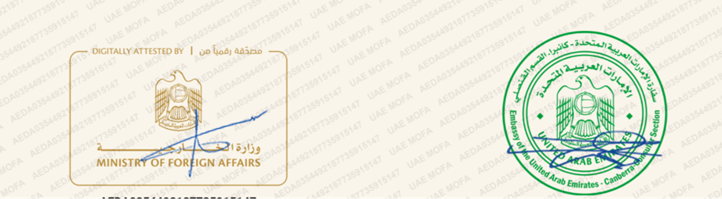
Based on initial review and recent practical experience, this new format appears, in certain cases, to include Ministry of Foreign Affairs (‘MOFA’) attestation as shown in the attestation seal on the left, as part of the consular legalisation process.
Before the change, once a document legalised abroad was received in the UAE, additional attestation by MOFA within the UAE was required before the document could be used.
After the change, where the new legalisation page contains both UAE Consulate attestation (right) and MOFA attestation (left), a further MOFA step in the UAE may no longer be required.
In such cases, the remaining steps would be limited to:
1. Translation of the document into Arabic; and
2. Ministry of Justice (‘MOJ’) attestation of the Arabic translation.
It is worth noting that the official fees remain unchanged for the combined legalisation, amounting to no more than AED 2,300. Previously, the total cost depended on the fees paid in the home country where the document was legalised. Under the new combined legalisation process, where MOFA attestation is already included, no additional MOFA fee is payable in the UAE.
This development is particularly relevant to our IP practice in the UAE, as legalised documents are a core component of many IP procedures, including (but not limited to):
Given the frequency with which we handle legalised documents on behalf of clients, this update has direct implications for:
This development reflects the UAE’s continued efforts to refine its processes, reduce bureaucracy, and facilitate more efficient and user-friendly services. For IP matters, this translates into greater operational efficiency, improved cost control and smoother execution of client work.
That said, this update does not indicate any change in the Ministry of Economy and Tourism’s approach to Power of Attorney requirements at various procedural stages. While there are ongoing discussions in this area, there has been no official decision or relaxation of the legalisation requirement confirmed to date. The only formal position currently in place remains the late filing option for Powers at the time of filing new applications.
Nevertheless, the introduction of a combined legalisation process may assist in obtaining duly legalised Powers more quickly, which can be particularly helpful where statutory deadlines are tight and timely submission is critical.
Should you have any inquiries or concerns regarding legalisation or other formality requirements for IP matters in the UAE, please contact Rouse UAE

